Day -4

Today was Day -4, the last day of my radiation treatments. It was the smoothest and easiest radiation session yet, and I even got to ring a brass bell to signify my graduation from the select club of radiation patients served at UC Davis Cancer Center. I am feeling pretty tired today, though, perhaps because of the cumulative effect of the radiation treatments themselves, perhaps because of the anti-anxiety drugs they’ve been giving me, perhaps because of the IV fluids they’ve been pumping into me 24/7 for a few days now (and which have added about 8 pounds of water weight to my body, as well as general sluggishness) or perhaps because I’m just not sleeping that well at night, despite the Ambien.

However, I did get back up on the exercise bike they have been so kind as to provide for me, and pedaled away for about 20 minutes in order to break a respectable enough sweat to merit a shower and change of outfit. If I can manage to do that every day, even just for a bit, they tell me the deep breaths will really help keep my lungs clear, and my lungs are the weak spot where infections tend to come to roost in my body during low-immunity periods.

And yes, I’m coming up on another one of those periods imminently, since tomorrow I will be getting a whopping dose of Cyclophosphamide (aka Cytoxan) which is very toxic to many things, among them lymphoma, immune systems, bladders, kidneys, hair, and probably a lot else they don’t care to mention. (Hence all the liquids, which will help to sluice away the unwanted vestiges of these chemicals.) So even though I will likely continue to feel more tired, I’ll need to make an extra effort to get up, move around, get on the bike etc. in order to keep my lungs clear and stimulate my body to get rid of the nasty leftovers.

The pleasant surprise around here is that I am (thus far) allowed out of my room after 9PM, as long as I’m gowned up to the max, so I can walk back and forth in the transplant unit hallways for a while before bedtime. Even that little bit of a walkabout does a lot of good.

My brother came in today for another visit; he had already taken his first doses of the Neupogen that will ramp up his stem cell production, so I wasn’t too bummed that he beat me in a lengthy game of chess. We’ll have a rematch tomorrow, I trust, on what I am excited to note will be Day -3. As long as you’re not suffering too badly (and believe me I’m really not) time kind of flies when you’re counting down to a new lease on life.

Day -5

Day -5 began a bit later than some, since I took an Ambien around 2:00 AM to see if I could avoid some of the tossing and turning that plagues me in the wee hours, especially in the hospital. That worked like a charm, but meant I was a bit bleary-eyed when the nurse came to give me my radiation pre-meds around 6:00. No disgrace in that, but good thing I wasn’t in charge of hanging up the Zofran etc.

The best part of the day was a visit from my brother James, who arrived in Sacramento late yesterday and who will begin taking shots of Neupogen tomorrow in preparation for his stem cell donation on Jan. 11. He’s been amazingly steady and supportive of this crazy process from the word go, and as readers of this blog will imagine, it was a huge boost just to set eyes on him. I could go on and on about how fortunate I am to have such a great guy as my brother, let alone as my life-saving donor, but I don’t want to gush more than is strictly necessary. As a very small token of my limitless appreciation, though, I did use my growing influence around here to talk the crack medical transport team into giving him a ride with us over to the Cancer Center where he was going to pick up his shots and meet with the transplant coordinator.

Finally, maybe I’m not such a loser in the Radiation Oncology team’s eyes after all. This afternoon, they dispensed with the repeated X-ray cross-checks on my positioning inside “the rack” or whatever they call the contraption I have now spent hours in without actually knowing its name. It was straight to the treatment: three zaps and I was done in less than half an hour. My calves barely felt it at all! Last day of radiation is tomorrow: Day -4.

P.S. For those keeping track, yes, the Senacot is working a treat.

Twelfth Night

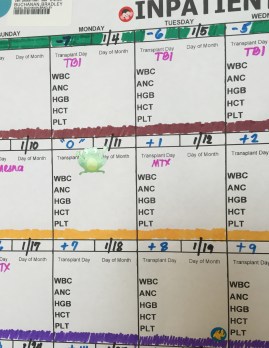
As Brad has been faithfully tracking, today is Day -5 on the transplant calendar. (I’m largely holed up at home today, not going into the hospital; I have a slight sore throat and they are very strict in saying that nobody with any illness should visit.) Below is the tracking poster taped up in his hospital room; all those inscrutable acronyms represent different lab results for the things they’re tracking daily, above all the all-important WBC, or white blood cell count, which represents his levels of immunity. (The handwritten ones are treatments he’ll receive; TBI, for instance, is total body irradiation.) The nurses do their best to make this somber daily slog festive and colorful. I can’t say I’m exactly sure why an excited frog represents transplant day, but I can’t object to it, either.

FullSizeRender 7

By another way of reckoning, today is also the twelfth day of Christmas, also known as Epiphany. (The word comes from the Greek for “reveal.”) January 6 is the day in the ecclesiastical calendar that the Magi showed up from the east, bearing their gifts, and thus a traditional time for gift-giving in Christian cultures—though this custom has moved entirely to the frenzied unwrapping of Christmas itself, and survives only in the longest of all Christmas carols, “The Twelve Days of Christmas,” with its onslaught of gifts (364 in total, by the time all the days have been counted).

Calling Epiphany Twelfth Night, or observing it at all, is so thoroughly forgotten that I find a lot of people confuse the twelve days of Christmas with the latter half of Advent, and think the song represents a countdown to Christmas. I was raised attending an Episcopal church, and the liturgical calendar (noted, at services, on the black sign up at the front that also displayed the numbers of the hymns we would sing) would note many seasons by counting after the holiday, as is done for the feast of Epiphany. (On January 6, I remember our church hosting a Christmas tree bonfire, one of many remnants of pagan light-festival celebration that linger in Christmas observance, and a reminder that all traditions layer, accrete, morph, and change.)

Brad’s brother James arrived here in Sacramento last night, and today he meets with the transplant team at the Cancer Center to get the shots he must give himself to boost his stem cell production before donation next Monday. Like the Magi, he came from the East (though the journey was less arduous, I hope), bearing gifts: in his case, millions of stem cells. We’d rather have those than all the gold, frankincense, and myrrh that could have fit in the overhead compartment. I’m also really glad he is bringing stem cells instead of partridges, drummers drumming, or swans a-swimming.

Aside from the carol, Shakespeare’s play is the other most familiar Twelfth Night reference in our culture, or at least familiar to Brad and me. Brad has been writing about it for a wide-ranging academic book project he’s been working on. I’ll let him tell you about the book if he wants to, but I’ll just say that when I went into the hospital on Monday, the table in his room was covered thickly with cut-up bits of paper, notes that he is rearranging into his manuscript. It was the first day of radiation, and he was feeling well enough to work (after the anti-anxiety medications wore off, that is). Slips of paper, books everywhere, a welter of ideas bubbling into a coherent whole: That’s been his method of writing for all the two decades I have known him, and seeing him at work, even in a hospital gown and with an IV of saline fluid dripping into his chest, was both cheering and reassuring.

I confess I haven’t read Twelfth Night in years, but it’s a quintessential Shakespearean romantic comedy, full of cross-dressing and mistaken identity and seemingly hopeless love triangles and tangles that dissolve, like magic, into pure happiness at the play’s end. But all the lightness has a somber undergirding: the play is also a story of siblings, separated by a disastrous shipwreck and thinking each other dead. Sebastian’s rescuer says he was “snatch’d one half out of the jaws of death.” Our small individual catastrophe is no shipwreck on the shores of Illyria, and we certainly know Brad’s Twelfth Night hospital stay is unlikely to involve any frothy comedy of mistaken identities or love triangles. But we hope it will snatch Brad out of the jaws of death—and seemingly magically resolve to reveal two healthy siblings and a happy ending.

Day -6

Day -6 began even earlier than Day -7, because I had just moved into my new, real room in the transplant unit. It is the biggest private room I have ever had, and well worth the small extra wait. I was excited to decorate and set up my work space, so I got up a bit earlier than planned to do that, which meant I had to take a power nap as we waited to get my radiation treatment.

Fortunately, that nap lasted a while. You see, there is a typical bureaucratic communication snafu between the powers that be at the Radiation Oncology Center and our helpful nurses on Davis 8, so even though Rac Onc Procedures dictate that I must have a 6-hour break between radiation sessions, they insist on having the more than officious transport crew come to get me at 2:15. No matter that they know that my morning radiation session ended at 9:10 AM or so and the soonest they can begin my treatment is thus 3:10. And no matter that the trip takes 5 minutes at the very most. And no matter that my nurse tried patiently to reason with them. So I get hustled over to wait for quite a while, plenty of time to snooze strapped into my padded gurney.

The radiation treatments themselves were uneventful today, since I did not feel faint or anxious, though I seem incapable of holding still for long enough to allow the techs to be confident enough than I’m in the right position (they have to double check every time with a quick x-ray or four) until I am well and truly sandwiched from every angle. As if to underscore this tendency in a comical manner, I managed to get hiccups twice today, once just as my morning radiation treatment was ending, and once just as they were fitting me in for my afternoon session. They said it wasn’t a problem, but I think they were trying to seem understanding while shoving me about in every possible gentle way.

Anyway, we’re now halfway through the radiation, and the only ill effect I’m feeling is a bit of incipient constipation from the Zofran they give me every day before the treatments. So we’re going to up our anti-blockage game from just Colace to Senacot as well. My apologies for these gastrointestinal details, but being badly bound up on the inside is among the worst, most uncomfortable feelings I’ve had in the hospital, including my collapsed lung in May. Spoiler alert: these tummy issues will be likely to surface again, albeit in the opposite, far more volatile mode, later on, after I get the new stem cells. So in the meantime, let’s simply look forward to a more regular Day -5.

Day -7

Today began early, for me: a 6:00 AM wakeup for pre-meds to get me set for my first 7:15 radiation session. Ativan was delivered, as promised, and I even managed to gobble down some early breakfast before the transport team (I think you could call them the SWAT team and they wouldn’t be surprised or need much of a change of outfit) arrived. I am not allowed to walk any part of this brief journey across the road, for reasons that escape me but no doubt have to do with the transport company’s self-protective policies, so the transport team straps me into a gurney, raises me to a surprisingly, rajah-like height, and wheels me along briskly. I also need to wear a special gown, a hairnet, gloves, shoe-covers, and a mask; that’s for my protection now that I’m deemed to be immune-compromised, so fair enough

The radiation treatments today were time-consuming and uncomfortable, to say the least. I was wedged into a plexiglass-and-metal pole frame which (at the risk of seeming paranoid and hostile) reminded me of something that might be used to detain Hannibal Lecter during one of his less friendly moods. I had to stand as still as possible in this device for the better part of half an hour as they adjusted it, readjusted it, made sharpie marks on my chest and back, and asked me to move over an inch or so, stand straighter, or what have you, and then finally administered the dose. I appreciated the care they were taking; after an earlier simulation and fitting visit they had fashioned blocks to protect some of my vital organs from the extremely high doses of energy they were proposing to send through my body, and these blocks needed to be placed in exactly the right spots, for obvious reasons. I was like a slice of meat being grilled from both sides (morning front, afternoon back) and they wanted to make sure the right bits were being cooked.

The morning session was the worse of the two sessions today, by some distance; they did not let me know when I could relax my posture and so my legs began to feel cramped and stiff right away (and kept cramping throughout). Also, despite the Ativan, I felt light-headed and began to break out in sweat. Uh oh, I thought, here we go again… You see, I had had similar squeamish symptoms during the simulation visit, and at that time I had asked to lie down for a while before the sweat actually broke out. The little rest had done me some good, but had interrupted the process to such an extent that my helpers had wandered off for a while, confusion hadreigned, and one of the procedures they had needed to do had ended up getting skipped. Afterwards, I had wondered if I might not have done better to soldier on, so to speak.

So today, when I feared I was going to faint, I worked harder to breathe deeply (not easy when your upper chest is being pressed into place); happily, I remembered that you use your diaphragm, which is lower down, when you inhale. I could see my sweat pouring down the glass plate in front of me as I leaned my forehead against it, but I realized that I was so well and truly surrounded by restraints that the very things that were making me feel claustrophobic, or like I was about to be executed, were in fact going to prevent me from falling down. I could sag gradually onto the bicycle-style seat they had wedged just under my butt, and I would be fine. So that’s what I did. My head slowly cleared, and the sweating soon stopped. I started to object when one the tech referred to my sweating as profuse, but when I saw the extent of the smear I’d made on the glass around me, I decided not to quibble.

By the afternoon session, I had overcome whatever my morning aversion to the radiation setup was, and recited World War One poetry to myself in a silent whisper instead of having a meltdown. My legs were still cramping up from having to hold the same pose for so long, but that was manageable with subtle weight shifts and a few (now for some reason officially permitted) breaks to stretch and wiggle. Everyone says the radiation sessions will get much shorter from now on, and thus easier to get through (their medical effects won’t truly begin to be felt till they have ended, apparently), which is a good enough reason to be glad that Day -7 is more or less over, and to look forward to Day -6.

Day -8

Today is Day -8, the day I was admitted to the UC Davis Medical Center to begin the transplant process. They count the days a bit differently here (maybe so that the numbers don’t seem too depressing as they mount up): Day -8 means there are eight days left till I get my new stem cells from my brother James, and tomorrow will be Day -7, and so on. Then, once the stem cells have been delivered (on Day 0) we start counting on the plus side: Day +1, Day +2, etc.

Before today could really become Day -8, though, I had to leave our house and make it into the hospital by 9:00 AM. I did depart, more or less when I was supposed to, but with very mixed feelings. On the one hand, not everyone with cancer has the privilege of getting a shot at a cure, but on the other hand, since I don’t actually feel sick and can’t locate any signs of renewed cancer growth, it feels a bit strange to be voluntarily committing myself to what promises to be an unpleasant, solitary, and unpredictable process. It was especially hard to say goodbye to the girls, though in (perhaps characteristically) different ways. 6 year-old Lucy rushed off quite early this morning for a play date with nary a backward glance, and I could barely detain her for a farewell hug and kiss, while ten year-old Nora (who had no social engagements and wanted to play a last bit of ping pong before I departed) got and gave multiple tearful hugs before I managed to leave. The nurse who showed me to my room asked if I had a cold; a natural mistake when you see someone with red eyes and the sniffles, I guess.

Actually, it’s not really my room, THE room, i.e., the one I’ll be spending the next 30-odd days in. It’s a private room, yes, with its own bathroom and everything I need, but it’s in the regular cancer ward on Davis 8 (i.e. the eighth floor of Davis Tower) not in the transplant unit proper. At first I was exceedingly demoralized to be told I’d have to wait for a room to open up in my final destination later on; in my emotional state, I desperately wanted to unpack, post some of the girls’ art and messages of love, and generally make myself somewhat at home. To make matters worse, it seemed I would not be moving into my real room for a few days, since the smaller room they proposed to put me in later today was not deemed suitable for someone who was staying for such a long time. After stewing for a while, I wished aloud to Kate that I could simply remain where I was for a few days, then move into the larger room when it opened up, thus skipping the middle stage and enabling me to settle in for the time being. Cogent and persistent advocate that she is, Kate persuaded the nurse to persuade the doctors to okay this plan.

So I unpacked and settled in after all, and Day -8 began with a small but distinct victory. Perhaps it was only a moral or psychological one, but it was a victory nonetheless. It was also a reminder that I have a lot going for me as I begin this process, including a supportive and engaged spouse. I am slated to begin my radiation treatments tomorrow morning around 7:30 AM, so I’ll be needing that support, as well as some Ativan, all over again on Day -7.

Calendars

IMG_9544
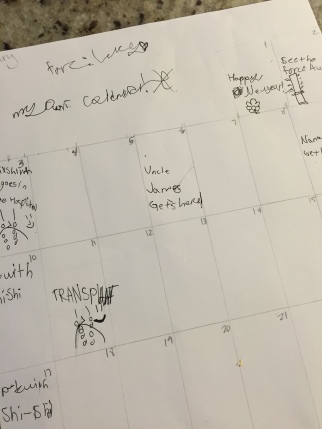
We have a lot of calendars around right now, even more than usual for the first few days of the year. The dry cleaner gave us one and a friend gave us one that will be the official one that hangs in the kitchen and we have a homemade one that Lucy filled in (as pictured) and Brad’s transplant nurse gave us three, all printed with the significant dates for his course of treatment. (This despite the fact that mostly we use a shared Google calendar and have for years.) All of these are tracking slightly different things, but mostly the same: significant dates for the transplant. We don’t know when Brad will come home from the hospital or when he will be better and we have no other plans for the year besides “get through the transplant,” and so our entire year is all but blank, except for this one looming things. Despite the unknown end date, the girls and I will cross off the days until Brad comes home.

Here’s what we have on the ones given by the transplant nurse—a rundown of his treatment: Today, January 2, Brad was supposed to call the oncology floor at the hospital to find out what time to go in tomorrow. He did, and he’s supposed to be there at nine. Tomorrow, he gets admitted. Monday, Tuesday, Wednesday, and Thursday: total-body radiation twice a day. (On Tuesday, also, Brad’s brother arrives here and then will start his prep.) The next two days: cytoxan (intensive chemotherapy). Next Sunday: a day of rest. Monday the 11th is what they call Day 0: the stem cells are harvested and transplanted into Brad that evening. And then we are waiting for engraftment—that is, for the stem cells to take and grow Brad a new immune system. Engraftment will likely take a couple of weeks, during which Brad will be tremendously vulnerable to infection and his white counts will be checked often until they begin to rise.

Of course, there are other things happening on our calendars. Lucy wrote on her calendar that today we were going to see Star Wars: The Force Awakens. We did, all four of us, and when the heroic music that all of us children of the 70s have heard a million times swelled, I could not help crying even though it came at a happy moment (no spoilers!). Brad pointed out that his transplant date is also the national college football championship. (I don’t think I’ll cry about that.) And the girls go back to school after winter break this Monday, and relatives and friends come to town, and late this month, oddly, marks twenty years since Brad’s and my first date.

Calendars, apparently, evolved from account books, and the word’s etymology seems to come from the root kele, “to shout”; on the first of the month, ancient bill collectors demanded that the accounts in their calendarium (account book) be settled up, and the word morphed from a descriptor of the account books to a more metaphorical meaning, an account of time. It has been odd and poignant that our calendars of Brad’s treatment are so closely aligned with the start of a new year. It serves as a reminder that we have been living on borrowed time for several weeks, and it is time to settle the account. I have been wishing I could freeze time, stop it somehow, or at least slow it, so that this doesn’t have to happen.

Another Latin-derived phrase has been ringing through my mind, these past days: Lente, lente, currite noctis equi (Run slowly, slowly, horses of the night). It’s from Ovid, but I actually know it from Marlowe’s Dr. Faustus. But the horses always go the same pace and the calendar’s new days come around again without fail. As Marlowe would have it, “The stars move still, time runs, the clock will strike.” Our borrowed time is up, and tomorrow morning in Brad goes to the hospital.

Countdown

This week between Christmas and the New Year always passes with a feeling of suspended animation. Nothing much ever happens, between holidays. Newspapers publish their end-of-year lists and projections for the year ahead. The old is winding down but still hanging on; the new has not yet started, so we think about it and wonder. That feels especially true for us this year. There’s now less than a week until Brad is admitted on January 3, to start the preparative regimen for his transplant. As I write this, though, we are at an outpatient unit of the hospital, which also has that suspended-animation feel on this Monday after Christmas. The receptionist at the Vascular Access Unit is subbing in for someone and there are forlorn holiday decorations hanging on outside.

We’re spending the morning at the hospital because Brad is having a new catheter placed in his chest (called a Hickman line, it’s external, unlike the ports many people have for cancer treatment). The catheter will be used during the transplant to deliver both the preparatory chemotherapy regimen and then the stem cells. Since May, he has had a PICC line (a catheter placed in his right arm), and it has served him well.

Many friends may know that Brad has always been squeamish. He doesn’t like needles or the sight or thought of blood or the idea of these catheters. In other words he is a truly terrible candidate for having blood cancer, but we don’t get to choose our illnesses. Placing the PICC, which was done in the hospital on an urgently needed basis so he could have chemotherapy, was an ordeal, and truth be told he has been apprehensive about the placement of this chest catheter. But this morning he has been impressively calm and stoic and matter-of-fact about it all.

Likewise, he has mostly been in very good and optimistic spirits as we edge ever closer to his admission. He’s been building the Lego Millennium Falcon that Santa brought Lucy, and shooting some pool on the new table he got us as a surprise family present, and meticulously obeying his oncologist’s suggestion that he enjoy a couple of beers before he goes in.

We have a little less than a week left with him at home, a countdown week that’s considerably less festive than the midnight 10, 9, 8… of the New Year, and I’m not sure I want to make too many top 10 lists from the year that has passed or make a lot of predictions about the one ahead. I’m trying, instead, to take a cue from Brad, and just soldier matter-of-factly through the fears and unknowns, maybe while shooting a little pool.

PS: If you came here looking for a recap, check out either my initial post, “The story so far,” or (for the briefer version) our About page.

Meal train

Just a quick post: Several friends have asked how they can help, and we appreciate your offers so much. There are some more ways on the About page (especially for non-local friends), but for locals, we have a Meal Train sign-up page kindly set up by our friend Ann (thanks, Ann!). Currently the December dates are filled, but in January and February I will need lots of help and will gratefully accept meals and offers of errands. (If you don’t see January dates right away, scroll forward on the calendar.) Everything is still on track for Brad to be admitted to the hospital on January 3 and he will almost certainly be there throughout January and into February, so I know I’ll be overwhelmed. We have already been the recipients of so much kindness this year and our gratitude to our local community of generous friends is enormous. Thank you all.

PS: If you came here looking for a recap of what’s been going on with Brad, you’ll find it in my initial post, “The story so far.”

The Point of No Return

Preparatory to being the stem cell donor for my upcoming transplant, my brother James traveled to Sacramento recently for an in-person medical examination, an X-ray, some confidential interviews, and yet more blood tests. He came through this day-long process with undiminished enthusiasm, though his travels to countries where malaria is widespread occasioned some concern from the medical team (though he has never actually had the disease himself) and his Canadian address caused two computers to seize up and nearly melt down (which was kind of funny). As I drove him to the airport, he relayed something that one of the many people he had talked to on his visit had told him. She had said, in essence, “You can still back out of this now, no problem. But there will come a point when, if you back out, your brother will die.”

I think he told me this by way of further reassurance, in case I needed it, that he wasn’t going to back out, either now or at any point in the future. I believed him, and still do, but the warning he was given brought me up short. I’d never really considered that particular fact about the stem cell transplant: the radiation and cytoxan I will be getting is so toxic to my immune system that I would not be able to survive at all without another specific person’s stem cells. It makes sense, of course, that one cannot live for long with no immune system whatsoever. The preparatory regimen is in fact designed to wipe my immune system out, as well as to attack any remaining cancer in my body, in order to allow the new immune system to graft more quickly and easily. Still, to hear that, at a certain stage, my life would depend entirely on receiving his stem cells, and his alone, was frightening. All kinds of paranoid, ridiculously selfish questions crossed my mind. What if his plane crashed? What if he were hit by a car on his way in to donate? Nobody else with suitably compatible stem cells would be found in time. Shouldn’t we keep him in a secure location while they administer the otherwise fatal doses of chemicals and/or X-rays to me? Shouldn’t there be a backup donor on call, just in case?

These are the kinds of questions that still occur to me, but they don’t really deserve serious answers. The chances of some tragic mishap befalling him during my window of complete vulnerability are so minute that not even the insurance companies are concerned about them. Still, I can’t help but wonder what it will feel like to reach that point, the point of no return, when my body loses any capacity to defend itself against even a minor infection, let alone cancer. Will I realize what’s going on, or find the emotional energy to care about such an abstract concept? Won’t I be too mired in the daily routine of radiation treatments, chemo infusions, and their side effects, to worry about where my brother is, what risks he might be taking or avoiding, what the statistical probability of his making it to the apheresis machine on January 11 actually is? The odds are so overwhelmingly in my favor, at least on this crucial logistical issue, that I can’t believe I’ll still be worrying about this kind of thing once the transplant process has actually gotten underway.

Behind every wildly irrational fear, however, lurks something much less crazy or foolish: something you might call ignorance, or else, in a different mood, a common-sense refusal to believe in miracles. I think part of what has produced this paranoia in me is my fundamental inability to comprehend or accept the biological, chemical logic of the transplant itself. It all seems like an elaborate, implausible magic trick that they are proposing to play on nature and mortality itself. How can these much-vaunted stem cells possibly live up to their reputation and perform all the tasks they are expected to do? They must inhabit my bloodstream, migrate to my bone marrow, produce millions more of themselves, and build not only a new immune system but a better one, in order to defeat the cancer my own immune system has apparently refused to fight. How far-fetched does that all sound? It sounds like something out of a science-fiction movie. Or out of a witch’s cookbook.

Intellectually, of course, I know that stem cells are a big deal for medical science precisely because they can do all this, and more, but I still don’t really get it. I don’t actually see the products of the astonishing transformations they can effect very often, and though I have met people who have undergone successful allogeneic transplants, they can’t explain how it all actually worked. The dumbed-down things you read in books about transplants don’t make them any more understandable, biologically, and I am insufficiently literate in scientific language to make much sense of more technical explanations. Therefore, I am reduced to a kind of disbelieving wonder when I contemplate the things that are supposed to bring me back safely from that point of no return my brother was warned about. It still feels as if I were going to jump off a cliff in the hope that I will somehow sprout wings and flutter gently to the ground.

Maybe some version of this feeling explains why they call people who have had allogeneic transplants “chimeras.” Not all types of these mythological creatures had wings, but they all look like the product of some unlikely evolutionary quirk or bizarre, unexpected coupling. In other words, they look like crazy shit some starving artist in ancient times dreamed up when he had nothing better to do. Or maybe, if he was really starving, when his whole life depended on it.