Day +3

Well, sure enough, as soon as I declare boredom with my routine, things change. This afternoon my throat was so damn dry and sore (a totally normal symptom of the near-total absence of my old immune system) that, aided by Kate’s presence, concern, and support, I finally did the sensible thing. I asked my doctor and nurse to help me out, and they were more than happy to do so, with a painkiller (which turns out to be Dilaudid), some throat lozenges, and a switch in my diet to something a whole lot easier to swallow (literally): protein shakes, “magic” ice cream cups, or some other cold, sweet things along those lines. They’re also going to get IV versions of the anti-rejection and antibiotic pills I’d been taking so that those will be administered painlessly; even a small sip of water is an effort right now.

I will admit that I’d been feeling rather proud of my surprising lack of mouth sores and my good appetite; the word “tough” had even been used in my connection (a first, as far as I can recall), but there was no denying that lunch had been a major chore to gulp down and that I needed to ask for some help. Even talking is something of an ordeal at the moment, and those who know me can guess how unusual a state of affairs that is. Fortunately, the Dilaudid didn’t make me too woozy to do my usual stint on the exercise bike, though it did make my large institutionalized-plastic La-Z-Boy knock-off feel awfully comfortable for an hour or so.
Day +2

My days post-transplant have already settled into a welcome but not especially stimulating routine: vitals and a new nurse at 7:00, trying to sleep more till breakfast; sitting and working on something writing-related; a visitor (Kate) or two (my parents) before or at lunch; then a dozy period in the afternoon when I pretend to be working hard but am often really nodding in my chair; then exercise on my bike and a shower before dinner; more work and doziness after dinner; a book to relax till last labs and bedtime anytime between 10:00 and 11:00 PM; then a long struggle to fall asleep against the various tides pressing on my bladder and belly; then, finally, a wee-hours plea for whatever sleep-inducing meds they will let me have. My mouth is dry, and so is my throat, since my mucous membranes are disappearing quickly from all the radiation and chemo, but I can still eat and drink without serious discomfort.

This is really as good as it’s going to get for quite a while, until the new stem cells take root and start making me a new fresh immune system. The short-term goal is a largely negative one: to avoid getting a nasty infection that would make life significantly worse. So I’m not sure how meaningful my daily updates will be for the next little while; it’s tempting to post something every day, just for fun (as I’ve started doing on Facebook), but in essence no news is good news, and thus I may just check in with a thought, a link to a song, or something every day (as proof of life, if nothing else) rather than continue with detailed narratives of events that are already starting to seem repetitious.

In that spirit, here’s a link to a Dire Straits song (“Brothers in Arms”) that I want to dedicate to my brother James: https://www.youtube.com/watch?v=k5JkHBC5lDs

I’ve loved this song since I heard it as a teenager, but I became obsessed with it during this past summer (well before I thought I’d need an allogeneic transplant with my brother’s stem cells) as I walked from home to the Cancer Center. The line about there being “so many different worlds” seemed to capture something bitterly true about the fragmentary nature human experience, and how wrapped up we can get in our own small lives, but the song’s calm acceptance of this uncomfortable cosmic fact gave me a certain serenity.


In the room where it happened

The word “transplant” sounds complex and possibly a little gory, like a surgery. But the procedure last night wasn’t at all. It was as dull as it is possible for a medical procedure to be, and that is a very good thing. In case anyone is interested in what actually happened during it, I thought I’d write up the details.

Brad was given Ativan, Benadryl, and some other meds about an hour in advance, so by the time I got to the hospital at 5:45 he was pretty sleepy. The transplant was scheduled for 6:00pm, after James’s stem cells had been conditioned and counted by the lab and sent to Brad’s hospital room. They arrived just a little later than that; the good news was that they collected nearly three times as many cells as they needed. So Brad got more than the minimum dose and they were able to cryopreserve some in case he needs more at some point. They use a preservative when they freeze the cells, so apparently transplants with preserved cells have a strong garlicky odor from the preservative, but with fresh stem cells there is none.

When the nurse brought the bag of stem cells into the room she asked both of us if we wanted to hold it. Brad said no but I said yes. I figured, when would I have another chance? The bag in my hand was heavy for its size and squishy, just a little bigger than my outstretched hand. The liquid inside looked and somehow felt, through the sturdy plastic, thick. Thicker than water. Thicker than blood, but a lighter color of red, really a bricklike dark pink like the preppy men’s pants they call Nantucket reds. (That color reminded me of a family vacation we took to a seaside resort in Maine a few years ago.)

The nurse gently took the bag back from me from me and hung it on the IV tower along with the bag of fluids that was already there. (They bumped Brad’s fluid drip back up for the transplant itself.) For her this was all routine, another day on shift. It was, in fact, the end of her shift, about 6:30 by this point. We were just waiting for the doctor to come in so the transplant could begin.

Once the transplant doctor arrived, the nurse attached bag to the drip where it mingled with IV fluid, and deftly and almost imperceptibly hooked it up to the lumen of the Hickman catheter that burrows under Brad’s chest and into his vein and from there leads directly to the heart. The heart was already being constantly monitored, its steady pumping recorded and able to push that viscous dark pink stuff to every corner of Brad’s body, where they will circulate until all his old bone marrow is dead and gone. And then, the cells—more than 600 million stem cells, 8 million for every kilogram of his body weight—will settle into his bones and grow him new marrow.

The drip was started, and that was about all the medical drama the evening provided. The doctor and the nurses talked about show dogs and dog breeds, about football, about former colleagues. Brad dozed off. The drip continued. After twenty minutes or so the transplant doctor said that if a reaction were going to happen, it would have happened by now, so he left. The reaction that they were concerned about was an immediate rejection; that is apparently more likely with donors whose blood type is different from the recipient. Brad and James do have the same blood type (which does mean that Brad’s blood type won’t change, a weird-but-true thing that happens in transplants). Later reactions of varying degrees of severity, called graft-versus-host disease, are likely but will happen after the new immune system engrafts.

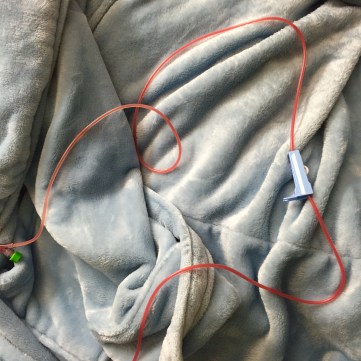
The nurses’ shift changed and the night nurse came on. She stayed in the room for the remaining hour or so of the slow, steady drip, monitoring things. I sat in a corner in my yellow robe and disposable face mask. I took a few pictures of the pink fluid coursing through Brad’s lines, because I liked the pattern it made.

FullSizeRender 8

After a while James arrived to say goodbye to Brad; James left early this morning to fly home. The drip finished about eight, slowly turning a paler and paler pink as the end of the bag was more and more diluted with the IV fluids, and that was it: a stem cell transplant.

It was a big relief to me to get past the actual transplant. For much of the past year, we’ve been leading up to that event, and getting to it felt like a real milestone even if the actual transplant was about as exciting as watching paint, well, drip. Frankly, I am not really interested in any further medical drama. Today, Brad is doing well overall, as he said in his post, but more tired today, and his white counts are steadily dropping, as expected in the wake of the intense radiation and chemo of the prep week. But he’s still eating, sitting up, using the exercise bike, and writing. Next up: more waiting.

Day +1

Day +1

Despite the dopiness I felt as the stem cells were being pumped into me yesterday evening, I had a lot of trouble falling asleep last night. There was certainly a lot to think about and some major emotional readjustment to do: for months, everything had been leading up to that climactic medical moment (kind of like the birth of a child), but suddenly the horizon looked (and still looks) a lot flatter. The complex transplant plans came together beautifully, and now we settle in to wait for engraftment (when the new stem cells come to root in my bone marrow and start making a new immune system). This doesn’t happen overnight, unfortunately; most estimates I’m hearing are between 2-3 weeks, if all goes well. Poor Lucy has been asking when I’m going to come home, and it’s hard not to have a proper answer ready to give her, beyond the long explanation of why I can’t come home today, as she seems to have expected. (I got Uncle James’s stem cells, didn’t I? Well, yes, but…)

One further resemblance between me and a very young child: when all else fails, sometimes judicious use of Benadryl will induce much-needed sleep.

Day 0

The number zero has an empty quality that doesn’t seem to belong at all to what’s been happening today. So many people have messaged and emailed and so on that it’s been as full a day as I can remember, and I have had lots of company in my hospital room (Kate and my parents, plus lots of medical business to transact and discuss with doctors, nurses, and the amazing transplant coordinator). My brother took his shots uncomplainingly, endured the aches and pains like a champ, and showed up in the apheresis room ready to donate some serious stem cells. He was charted on something like world-record pace, and delivered double what was needed, so we have plenty of material to work with (even a future top-up if needed), again he can get on his plane tomorrow and resume his own rightful life on schedule. I received the cells between 6:30 and 8:00 or so, mostly dozing from the Ativan and Benadryl they gave me. I’m as tired as I’ve felt for many weeks, but anything but empty; instead, I’m full of love, gratitude, and hope.

The stars look very different today

IMG_9585

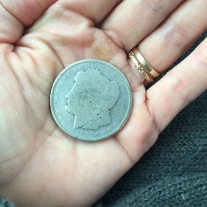
It is day 0. Transplant day. I am not usually the superstitious type but I got out my grandfather’s lucky silver dollar and am carrying it with me today. It can’t hurt. Right now James is at UC Davis Medical Center hooked up to an apheresis machine, staying still while they take many, many millions stem cells out of his body. (Update: I misunderstood and misstated the number of stem cells being donated in the original version of this post; they’re actually taking five million per kilo of Brad’s body weight, and as of this writing they think James’s donation is on track to produce twice that amount.) This should take about six hours, if all goes well. After that, somebody will whisk this alive, life-saving matter to a lab for conditioning and counting and then it will be delivered to Brad sometime in the evening—the aim is to do it around 6pm, but hospital time moves slowly and the all-important shift change looms at 7, so I’m betting on 8pm. By all accounts the stem cell transplant itself is severely anticlimactic, but I want to be there anyway.

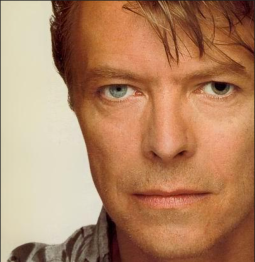
Last night before I went to bed I looked at Twitter and saw a tweet saying the user had seen that David Bowie had died but that it might be a hoax, the account might be hacked. I went to bed not sure if it was true and woke up to social media awash in tributes, links to songs, pictures of Bowie, in all of his many ever-changing personae. (One of the most arresting of Bowie’s physical characteristics, his two differently colored eyes, has sparked speculation that he may be a genetic chimera, though online sources say that the difference is due to a paralyzed pupil.)

Screen Shot 2016-01-11 at 12.16.28 PM

I never know quite what to say about, or how to mark, a celebrity death. Today, though, I thought of Bowie’s wife and family—I had not realized he had a daughter so young, just 15—and of the privacy with which he surrounded his death from an unnamed form of cancer, and I thought of the enormous range of his songs, which I put on many a mix tape in my teenage years. Yes, they were actual cassettes. I was born in 1972, the year “Suffragette City” (probably my favorite Bowie song) came out on The Rise and Fall of Ziggy Stardust and the Spiders from Mars; “Let’s Dance” was a staple at our junior-high dances; and I remember “Space Oddity”—though it came out far earlier—played over and over after the Challenger disaster. And of course it was the poignant, sorrowful story of Major Tom trapped in space that first popped into my head this morning, its isolated tragedy of overreaching science seeming somehow uncomfortably close to the bizarre microscopic, interior magic of stem cell transplant.

But Brad’s is not, will not be, a Major Tom story. He is floating in an isolation chamber, high above our neighborhood, but there is something we can do, something the doctors are doing, today. And we hope it will wreak a Bowie-like transformation in him (maybe with less makeup if Brad’s past tastes are indicative of anything, but hey, if he gets better he can do whatever he wants). Bowie the chameleon was the master of reinvention and transformation. His death is doubtless a deep, abiding, and very private grief for his family, and I hope I don’t disrespect or lessen that when I choose to take a symbolic meaning from his fame and its story. May the stem cells Brad gets today, and Brad himself, be just as good at reinvention and rising from the ashes as was twentieth-century pop’s greatest chimera.

Day -1

I know it’s a terrible, pretentious cliché for me to quote a famous poem here, but since it’s the last day of my old life (in a certain weird biological sense) and since it’s been an uneventful day from a medical point of view (no more chemo, just a few antibiotics),  I am going to indulge myself. “Byzantium,” by W.B. Yeats, has always struck me as a kind of esoteric vision that only someone as strange as Yeats could manage to have, and though I love its obsessive cadences and urgency, I will confess that I have never managed to make much sense of it myself, though I’ve taught it (or tried) and have read a fair amount about Yeats’s wacky ideas when he wrote it. However, as I’ve walked around in the hall outside my room these past few nights, I have been haunted by certain (OK, many) lines in the poem that suddenly seem to resonate with my own current situation. There’s a lot in it about blood, death, and rebirth, and the poem’s truly astonishing ending captures something violent yet wonderful about the physiological transformation I’m in the process of undergoing, I suppose. Anyway, for those of you who want to read it again and picture me patrolling the halls in a garish yellow gown chanting it softly to myself, here it is:


The unpurged images of day recede;

The Emperor’s drunken soldiery are abed;

Night resonance recedes, night-walkers’ song

After great cathedral gong;

A starlit or a moonlit dome disdains

All that man is,

All mere complexities,

The fury and the mire of human veins.


Before me floats an image, man or shade,

Shade more than man, more image than a shade;

For Hades’ bobbin bound in mummy-cloth

May unwind the winding path;

A mouth that has no moisture and no breath

Breathless mouths may summon;

I hail the superhuman;

I call it death-in-life and life-in-death.


Miracle, bird or golden handiwork,

More miracle than bird or handiwork,

Planted on the starlit golden bough,

Can like the cocks of Hades crow,

Or, by the moon embittered, scorn aloud

In glory of changeless metal

Common bird or petal

And all complexities of mire or blood.


At midnight on the Emperor’s pavement flit

Flames that no faggot feeds, nor steel has lit,

Nor storm disturbs, flames begotten of flame,

Where blood-begotten spirits come

And all complexities of fury leave,

Dying into a dance,

An agony of trance,

An agony of flame that cannot singe a sleeve.


Astraddle on the dolphin’s mire and blood,

Spirit after spirit! The smithies break the flood,

The golden smithies of the Emperor!

Marbles of the dancing floor

Break bitter furies of complexity,

Those images that yet

Fresh images beget,

That dolphin-torn, that gong-tormented sea.


Day -2

Another uneventful day of Cyclophosphamide and Mesna, which means we have now well and truly entered “the point of no return”: they have given me enough toxins to eliminate my old immune system, and are preparing to give me my new one. Thus I will begin anti-rejection drugs such as tacrolimus tomorrow which will smooth the transition for accepting my new stem cells from my brother. Though I have had my share of nervous moments about this exact phase of the transplant, everyone seems to feel things are going very well, and in the end it is very hard not to assimilate this to all those other moments where I have essentially put my life into the hands of experts who are familiar with the risks and rewards of the rarefied methods they employ. In other words, the miracle I thought you kind of had to strive for has started morphing into something that everybody treats as pretty banal. Which is really just as well, come to think of it; not every transplant patient is so lucky.

My parents arrived today to visit and help with the kids; it was of course great to see them, and their presence, as well as my brother’s, have only added to the strange but welcome sense of normality that I’m enjoying in the hospital. And yes, after some anxious moments, my brother collected his gold medal in the 100-yard dash while I galloped home in the 400 (we finished “Chariots of Fire”).

A few odd side notes: my weight has reached an all-time high of 190+ pounds, thanks to all the IV fluids they continue to pump in. My tongue is so swollen that I bit it twice last night in my sleep (I have to sleep on my back exclusively, it seems). I am snoring like crazy from the liquids in my sinuses, so I feel like I have developed instant sleep apnea. Aside from all that, I feel pretty good: I’m still riding the exercise bike to break a sweat, and my throat and mouth are more or less sore free (aside from self-inflicted teeth wounds). However, I no longer use a tooth brush, or even the kids’ toothpaste I have gotten used to over the past year or so, but rather these odd sponges that just kind of swab out your mouth.

I’m looking forward to Day -1, because that will be my last day in negative numbers. Starting from zero will seem like a head start, I’m thinking.


Day -3, Part 2

Perhaps some of you will have guessed that I broke up today’s update into two parts because I was apprehensive about the way things might go once the dose of cyclophosphamide hit my system. Well, I needn’t have worried, at least not today: none of the gory or alarming things they mention as possibilities came to pass, and I had a very pleasant visit with my brother James. We watched the first part of “Chariots of Fire,” a movie that (I believe) played a formative role in both of our lives: it turned me into an anglophile (or, more accurately, someone with a strong curiosity about social changes and tensions in post-WWI Britain) and it inspired him to excel as a middle-distance runner: he ended up attending the University of North Carolina, Chapel Hill, on a track scholarship. We’ve since discussed which of us was more like Eric Liddell as a teenager/young man (I say me, since I tended to get by on inspiration, wild obsessions and ascetic dedication to esoteric causes) and which more like Harold Abrahams (I say him, because he showed more actual grit, focus and ambition in making himself a real runner for one thing, whereas I only ran till I stopped beating him, but also since then as he has carved out a downright noble career with various NGOs around the world). In the end, though, we both just love the movie and wanted to see it again together after all these years. It has a hugely bittersweet quality, of course, since neither one of us can run very much anymore (he’s had back trouble and I am, well, not currently in any kind of running condition), but the sight of those carefree young men running in the surf along the coast of Kent is endlessly beautiful. And then there’s the music…

We have made a date to finish the movie tomorrow, and so we will see our respective alter egoes  collect their gold medals on transplant Day -2. I can’t wait.

Day -3 Part 1

Day -3 Part 1

It’s a total change of rhythm this morning: since I’m not going over to the Cancer Center for radiation treatment, there’s no need for an early breakfast or rushed departure, which is nice. On the other hand, they are now pumping saline solution into me at twice the previous (already uncomfortable) pace, so my waterlogged feeling yesterday is now even more pronounced. They’re also getting ready to give me Mesna, a so-called “rescue medicine” that, according to Wikipedia (sorry, fellow academics for the shoddy source) “is used therapeutically to reduce the incidence of haemorrhagic cystitis and haematuria when a patient receives ifosfamide or cyclophosphamide for cancer chemotherapy.” Since I’m getting a very concentrated dose of cyclophosphamide in a few hours, and don’t much like the sound of haemorrhagic cystitis and haematuria, I’m all for the extra liquids and the Mesna, which will help me evacuate the extra toxins from my body ASAP, at least in theory. I have no idea how I’ll be feeling later, so I’m making this entry now and am going to jump on my bike before breakfast, in case I don’t feel like it later on. More to come post-cyclophosphamide…