Day +12

Today marks Brad’s 20th day in the hospital, meaning he’s now pushed past his previous hospitalization-length record of 19 days, set back in May. Unfortunately, today has not seen much of an upswing from the discouraging challenges of yesterday. His C. diff continues and is being treated with oral vancomycin; so far, luckily, he doesn’t seem to have the abdominal pain that’s often associated with such an infection.
IMG_9666

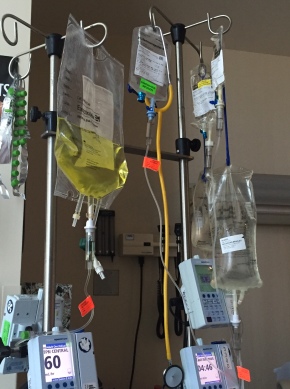
His IV tower is crowded with all his other medications: He’s also on several other broad-spectrum antibiotics (the rest of them all given via IV), the immune suppressant medication he will continue on for several months, TPN (nutrition given via IV; that’s the not-so-delicious-looking yellow fluid), and saline fluid, plus IV acetaminophen when he spikes a fever. For some reason, this last drug—which is just Tylenol,  but given intravenously—sends the entire medical staff and pharmacy into a tizzy. Apparently it’s extraordinarily expensive and the hospital pharmacist is strongly opposed to dispensing it. (Surely, however, the cost of the Tylenol is just a drop in the bucket of what this whole hospitalization will cost? It’s hard to fathom how much that might be, and every time I think about it I am grateful for our excellent insurance plan, which comes to us courtesy of the taxpayers of California. Thanks, everyone reading this from in state, and let me just take a moment to acknowledge how privileged we are in this regard and say that I wish everyone in the U.S., and indeed everywhere, had equal access to this level of medical care when they need it.) But Brad can’t swallow pills at all and even liquids are a challenge, so his medical team has been going to bat for him and fighting to get him every dose, to lower his fever. I told the doctor yesterday that if they need someone else to get on the phone and yell at the pharmacist I might have a little aggression to spare these days.

Speaking of fever, it’s been spiking a lot, up to 104ºF last night. That’s sapping his energy, and he’s been dozing most of the time while I have been at the hospital today. His breathing has also been a little more difficult and shallow, probably—according to the doctor—as much in consequence of the fever as of the pneumonia identified on CT.

This morning, however, the transplant doctor did say that the lung inflammation may be more from his early and relatively rapid engraftment—which, in a glimmer of good news, is continuing—than from an infection. To be on the safe side, though, the transplant doctors are bringing in a consult from the Infectious Diseases specialists and if the breathing does not improve they will call in the pulmonary team as well. So, while these setbacks aren’t any fun for Brad (to put it mildly) and are worrying for the rest of us, I have a lot of confidence in the treatment he’s receiving and how attentive his care team is to even the very smallest details of his condition.


We were told, well before the transplant, that recovery from it would not be linear, and this week certainly confirms that it has been and will be a roller coaster. I never did like riding roller coasters, and it turns out I like metaphorical ones no better than the nauseating ones in amusement parks. We were all so encouraged, a few days ago, to learn that he was starting to engraft, and it was hard not to think that it would then be a relatively smooth path upward. But we’ve had another sickening drop. It’s equally hard to stay confident that a corresponding rise will come, but it will.
Day +9

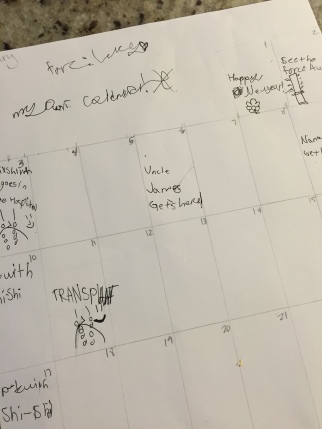
This morning Lucy asked me when Daddy is coming home. I don’t know, I had to answer. I had her count up the days Brad has been in the hospital, on the calendar we have been Xing off. Per our six-year-old, this is Brad’s seventeenth day in the hospital. He’s therefore shortly to exceed his previous record for length of hospitalization (nineteen days), set back in May. That’s the kind of personal best nobody wants, but such is life with cancer.

I told Lucy that seventeen days is most likely about halfway through Brad’s hospital stay this time around. Her next question was: why does he feel worse now, even though he got the stem cells last week? It’s a good question, and I tried to explain in kid terms to her why he feels crappy now, and why his recovery will be slow and will contain quite a few ups and downs. Coincidentally, just yesterday Brad suggested that we post an overview of his medical status today; he’s been keeping everyone updated on the day-by-day, but we thought a big-picture look at where we are and what we can expect going forward could be helpful. So here, not quite in the terms I used to explain to Lucy, is that look.

Right now he is at an absolute nadir in terms of his white blood count, and he say he feels like it must be a nadir in how he feels as well, that he can’t possibly feel worse than the mixture of fatigue and discomfort that he’s felt all day today. (Hence my writing today’s post.) That’s unfotunately as expected—the myeloablative preparatory regimen of intensive chemo and radiation that his oncologist selected was intended to wipe out everything in his bone marrow, plus all his cancer, plus, unfortunately, a lot of other stuff besides—like his hair, any coating on his mucous membranes, and all his energy. While these side effects are miserable, they are medically expected and also reasonably well managed by the nursing staff and doctors.

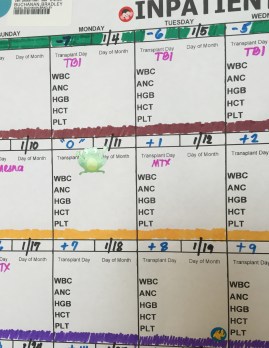
In a few days’ time his white blood counts (recorded on a special calendar the nurses posted in his room) should start to creep up, though we don’t know exactly when. The climb in his WBC numbers will mean that the stem cells he received in the transplant on Day 0 are starting to engraft, or repopulate his bone marrow. In other words, they’ll move in and start growing him a new immune system. Brad’s transplant nurse said that engraftment can start happening as early as Day +12, though a little later is more typical.

Once engraftment is taking place, the side effects from the preparatory regimen should start to fade—but new side effects in the form of graft vs. host disease (GVHD) will likely start to pop up. We can’t know what these will be, but they stem from the new immune system failing to recognize the host (Brad) as its new home, and treating it like a disease instead. Often, they look like a localized allergic reaction, and they are typically controlled with steroids. Because GVHD can flare up in unexpected ways and places any time, it’s likely that Brad’s trajectory of recovery will look less like a continual upward slope and more like building waves, with plenty of peaks and valleys.

For the long term, the medical team also keeps GVHD under control with immune suppressant medications, which Brad will be on for several months to come. This keeps the new immune system in check so it doesn’t attack the host, but also lets it settle in and start to function. Brad’s oncologist, however, is hoping to see a little GVHD; that indicates that the immune system is on the ball, functioning well, and ready to attack the cancer that it must fight in future.

So, all this is a delicate medical balancing act, a micro-drama taking place on a cellular level. But from the outside, it just looks like a lot of waiting—and will for a long time. That’s hard not only for six-year-olds, but for this particular grown-up as well.

In the room where it happened

The word “transplant” sounds complex and possibly a little gory, like a surgery. But the procedure last night wasn’t at all. It was as dull as it is possible for a medical procedure to be, and that is a very good thing. In case anyone is interested in what actually happened during it, I thought I’d write up the details.

Brad was given Ativan, Benadryl, and some other meds about an hour in advance, so by the time I got to the hospital at 5:45 he was pretty sleepy. The transplant was scheduled for 6:00pm, after James’s stem cells had been conditioned and counted by the lab and sent to Brad’s hospital room. They arrived just a little later than that; the good news was that they collected nearly three times as many cells as they needed. So Brad got more than the minimum dose and they were able to cryopreserve some in case he needs more at some point. They use a preservative when they freeze the cells, so apparently transplants with preserved cells have a strong garlicky odor from the preservative, but with fresh stem cells there is none.

When the nurse brought the bag of stem cells into the room she asked both of us if we wanted to hold it. Brad said no but I said yes. I figured, when would I have another chance? The bag in my hand was heavy for its size and squishy, just a little bigger than my outstretched hand. The liquid inside looked and somehow felt, through the sturdy plastic, thick. Thicker than water. Thicker than blood, but a lighter color of red, really a bricklike dark pink like the preppy men’s pants they call Nantucket reds. (That color reminded me of a family vacation we took to a seaside resort in Maine a few years ago.)

The nurse gently took the bag back from me from me and hung it on the IV tower along with the bag of fluids that was already there. (They bumped Brad’s fluid drip back up for the transplant itself.) For her this was all routine, another day on shift. It was, in fact, the end of her shift, about 6:30 by this point. We were just waiting for the doctor to come in so the transplant could begin.

Once the transplant doctor arrived, the nurse attached bag to the drip where it mingled with IV fluid, and deftly and almost imperceptibly hooked it up to the lumen of the Hickman catheter that burrows under Brad’s chest and into his vein and from there leads directly to the heart. The heart was already being constantly monitored, its steady pumping recorded and able to push that viscous dark pink stuff to every corner of Brad’s body, where they will circulate until all his old bone marrow is dead and gone. And then, the cells—more than 600 million stem cells, 8 million for every kilogram of his body weight—will settle into his bones and grow him new marrow.

The drip was started, and that was about all the medical drama the evening provided. The doctor and the nurses talked about show dogs and dog breeds, about football, about former colleagues. Brad dozed off. The drip continued. After twenty minutes or so the transplant doctor said that if a reaction were going to happen, it would have happened by now, so he left. The reaction that they were concerned about was an immediate rejection; that is apparently more likely with donors whose blood type is different from the recipient. Brad and James do have the same blood type (which does mean that Brad’s blood type won’t change, a weird-but-true thing that happens in transplants). Later reactions of varying degrees of severity, called graft-versus-host disease, are likely but will happen after the new immune system engrafts.

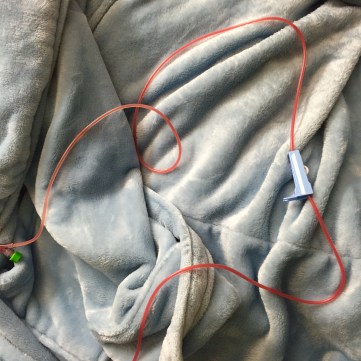
The nurses’ shift changed and the night nurse came on. She stayed in the room for the remaining hour or so of the slow, steady drip, monitoring things. I sat in a corner in my yellow robe and disposable face mask. I took a few pictures of the pink fluid coursing through Brad’s lines, because I liked the pattern it made.

FullSizeRender 8

After a while James arrived to say goodbye to Brad; James left early this morning to fly home. The drip finished about eight, slowly turning a paler and paler pink as the end of the bag was more and more diluted with the IV fluids, and that was it: a stem cell transplant.

It was a big relief to me to get past the actual transplant. For much of the past year, we’ve been leading up to that event, and getting to it felt like a real milestone even if the actual transplant was about as exciting as watching paint, well, drip. Frankly, I am not really interested in any further medical drama. Today, Brad is doing well overall, as he said in his post, but more tired today, and his white counts are steadily dropping, as expected in the wake of the intense radiation and chemo of the prep week. But he’s still eating, sitting up, using the exercise bike, and writing. Next up: more waiting.

The stars look very different today

IMG_9585

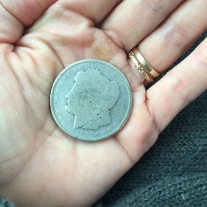
It is day 0. Transplant day. I am not usually the superstitious type but I got out my grandfather’s lucky silver dollar and am carrying it with me today. It can’t hurt. Right now James is at UC Davis Medical Center hooked up to an apheresis machine, staying still while they take many, many millions stem cells out of his body. (Update: I misunderstood and misstated the number of stem cells being donated in the original version of this post; they’re actually taking five million per kilo of Brad’s body weight, and as of this writing they think James’s donation is on track to produce twice that amount.) This should take about six hours, if all goes well. After that, somebody will whisk this alive, life-saving matter to a lab for conditioning and counting and then it will be delivered to Brad sometime in the evening—the aim is to do it around 6pm, but hospital time moves slowly and the all-important shift change looms at 7, so I’m betting on 8pm. By all accounts the stem cell transplant itself is severely anticlimactic, but I want to be there anyway.

Last night before I went to bed I looked at Twitter and saw a tweet saying the user had seen that David Bowie had died but that it might be a hoax, the account might be hacked. I went to bed not sure if it was true and woke up to social media awash in tributes, links to songs, pictures of Bowie, in all of his many ever-changing personae. (One of the most arresting of Bowie’s physical characteristics, his two differently colored eyes, has sparked speculation that he may be a genetic chimera, though online sources say that the difference is due to a paralyzed pupil.)

Screen Shot 2016-01-11 at 12.16.28 PM

I never know quite what to say about, or how to mark, a celebrity death. Today, though, I thought of Bowie’s wife and family—I had not realized he had a daughter so young, just 15—and of the privacy with which he surrounded his death from an unnamed form of cancer, and I thought of the enormous range of his songs, which I put on many a mix tape in my teenage years. Yes, they were actual cassettes. I was born in 1972, the year “Suffragette City” (probably my favorite Bowie song) came out on The Rise and Fall of Ziggy Stardust and the Spiders from Mars; “Let’s Dance” was a staple at our junior-high dances; and I remember “Space Oddity”—though it came out far earlier—played over and over after the Challenger disaster. And of course it was the poignant, sorrowful story of Major Tom trapped in space that first popped into my head this morning, its isolated tragedy of overreaching science seeming somehow uncomfortably close to the bizarre microscopic, interior magic of stem cell transplant.

But Brad’s is not, will not be, a Major Tom story. He is floating in an isolation chamber, high above our neighborhood, but there is something we can do, something the doctors are doing, today. And we hope it will wreak a Bowie-like transformation in him (maybe with less makeup if Brad’s past tastes are indicative of anything, but hey, if he gets better he can do whatever he wants). Bowie the chameleon was the master of reinvention and transformation. His death is doubtless a deep, abiding, and very private grief for his family, and I hope I don’t disrespect or lessen that when I choose to take a symbolic meaning from his fame and its story. May the stem cells Brad gets today, and Brad himself, be just as good at reinvention and rising from the ashes as was twentieth-century pop’s greatest chimera.

Twelfth Night

As Brad has been faithfully tracking, today is Day -5 on the transplant calendar. (I’m largely holed up at home today, not going into the hospital; I have a slight sore throat and they are very strict in saying that nobody with any illness should visit.) Below is the tracking poster taped up in his hospital room; all those inscrutable acronyms represent different lab results for the things they’re tracking daily, above all the all-important WBC, or white blood cell count, which represents his levels of immunity. (The handwritten ones are treatments he’ll receive; TBI, for instance, is total body irradiation.) The nurses do their best to make this somber daily slog festive and colorful. I can’t say I’m exactly sure why an excited frog represents transplant day, but I can’t object to it, either.

FullSizeRender 7

By another way of reckoning, today is also the twelfth day of Christmas, also known as Epiphany. (The word comes from the Greek for “reveal.”) January 6 is the day in the ecclesiastical calendar that the Magi showed up from the east, bearing their gifts, and thus a traditional time for gift-giving in Christian cultures—though this custom has moved entirely to the frenzied unwrapping of Christmas itself, and survives only in the longest of all Christmas carols, “The Twelve Days of Christmas,” with its onslaught of gifts (364 in total, by the time all the days have been counted).

Calling Epiphany Twelfth Night, or observing it at all, is so thoroughly forgotten that I find a lot of people confuse the twelve days of Christmas with the latter half of Advent, and think the song represents a countdown to Christmas. I was raised attending an Episcopal church, and the liturgical calendar (noted, at services, on the black sign up at the front that also displayed the numbers of the hymns we would sing) would note many seasons by counting after the holiday, as is done for the feast of Epiphany. (On January 6, I remember our church hosting a Christmas tree bonfire, one of many remnants of pagan light-festival celebration that linger in Christmas observance, and a reminder that all traditions layer, accrete, morph, and change.)

Brad’s brother James arrived here in Sacramento last night, and today he meets with the transplant team at the Cancer Center to get the shots he must give himself to boost his stem cell production before donation next Monday. Like the Magi, he came from the East (though the journey was less arduous, I hope), bearing gifts: in his case, millions of stem cells. We’d rather have those than all the gold, frankincense, and myrrh that could have fit in the overhead compartment. I’m also really glad he is bringing stem cells instead of partridges, drummers drumming, or swans a-swimming.

Aside from the carol, Shakespeare’s play is the other most familiar Twelfth Night reference in our culture, or at least familiar to Brad and me. Brad has been writing about it for a wide-ranging academic book project he’s been working on. I’ll let him tell you about the book if he wants to, but I’ll just say that when I went into the hospital on Monday, the table in his room was covered thickly with cut-up bits of paper, notes that he is rearranging into his manuscript. It was the first day of radiation, and he was feeling well enough to work (after the anti-anxiety medications wore off, that is). Slips of paper, books everywhere, a welter of ideas bubbling into a coherent whole: That’s been his method of writing for all the two decades I have known him, and seeing him at work, even in a hospital gown and with an IV of saline fluid dripping into his chest, was both cheering and reassuring.

I confess I haven’t read Twelfth Night in years, but it’s a quintessential Shakespearean romantic comedy, full of cross-dressing and mistaken identity and seemingly hopeless love triangles and tangles that dissolve, like magic, into pure happiness at the play’s end. But all the lightness has a somber undergirding: the play is also a story of siblings, separated by a disastrous shipwreck and thinking each other dead. Sebastian’s rescuer says he was “snatch’d one half out of the jaws of death.” Our small individual catastrophe is no shipwreck on the shores of Illyria, and we certainly know Brad’s Twelfth Night hospital stay is unlikely to involve any frothy comedy of mistaken identities or love triangles. But we hope it will snatch Brad out of the jaws of death—and seemingly magically resolve to reveal two healthy siblings and a happy ending.

Calendars

IMG_9544
We have a lot of calendars around right now, even more than usual for the first few days of the year. The dry cleaner gave us one and a friend gave us one that will be the official one that hangs in the kitchen and we have a homemade one that Lucy filled in (as pictured) and Brad’s transplant nurse gave us three, all printed with the significant dates for his course of treatment. (This despite the fact that mostly we use a shared Google calendar and have for years.) All of these are tracking slightly different things, but mostly the same: significant dates for the transplant. We don’t know when Brad will come home from the hospital or when he will be better and we have no other plans for the year besides “get through the transplant,” and so our entire year is all but blank, except for this one looming things. Despite the unknown end date, the girls and I will cross off the days until Brad comes home.

Here’s what we have on the ones given by the transplant nurse—a rundown of his treatment: Today, January 2, Brad was supposed to call the oncology floor at the hospital to find out what time to go in tomorrow. He did, and he’s supposed to be there at nine. Tomorrow, he gets admitted. Monday, Tuesday, Wednesday, and Thursday: total-body radiation twice a day. (On Tuesday, also, Brad’s brother arrives here and then will start his prep.) The next two days: cytoxan (intensive chemotherapy). Next Sunday: a day of rest. Monday the 11th is what they call Day 0: the stem cells are harvested and transplanted into Brad that evening. And then we are waiting for engraftment—that is, for the stem cells to take and grow Brad a new immune system. Engraftment will likely take a couple of weeks, during which Brad will be tremendously vulnerable to infection and his white counts will be checked often until they begin to rise.

Of course, there are other things happening on our calendars. Lucy wrote on her calendar that today we were going to see Star Wars: The Force Awakens. We did, all four of us, and when the heroic music that all of us children of the 70s have heard a million times swelled, I could not help crying even though it came at a happy moment (no spoilers!). Brad pointed out that his transplant date is also the national college football championship. (I don’t think I’ll cry about that.) And the girls go back to school after winter break this Monday, and relatives and friends come to town, and late this month, oddly, marks twenty years since Brad’s and my first date.

Calendars, apparently, evolved from account books, and the word’s etymology seems to come from the root kele, “to shout”; on the first of the month, ancient bill collectors demanded that the accounts in their calendarium (account book) be settled up, and the word morphed from a descriptor of the account books to a more metaphorical meaning, an account of time. It has been odd and poignant that our calendars of Brad’s treatment are so closely aligned with the start of a new year. It serves as a reminder that we have been living on borrowed time for several weeks, and it is time to settle the account. I have been wishing I could freeze time, stop it somehow, or at least slow it, so that this doesn’t have to happen.

Another Latin-derived phrase has been ringing through my mind, these past days: Lente, lente, currite noctis equi (Run slowly, slowly, horses of the night). It’s from Ovid, but I actually know it from Marlowe’s Dr. Faustus. But the horses always go the same pace and the calendar’s new days come around again without fail. As Marlowe would have it, “The stars move still, time runs, the clock will strike.” Our borrowed time is up, and tomorrow morning in Brad goes to the hospital.

Countdown

This week between Christmas and the New Year always passes with a feeling of suspended animation. Nothing much ever happens, between holidays. Newspapers publish their end-of-year lists and projections for the year ahead. The old is winding down but still hanging on; the new has not yet started, so we think about it and wonder. That feels especially true for us this year. There’s now less than a week until Brad is admitted on January 3, to start the preparative regimen for his transplant. As I write this, though, we are at an outpatient unit of the hospital, which also has that suspended-animation feel on this Monday after Christmas. The receptionist at the Vascular Access Unit is subbing in for someone and there are forlorn holiday decorations hanging on outside.

We’re spending the morning at the hospital because Brad is having a new catheter placed in his chest (called a Hickman line, it’s external, unlike the ports many people have for cancer treatment). The catheter will be used during the transplant to deliver both the preparatory chemotherapy regimen and then the stem cells. Since May, he has had a PICC line (a catheter placed in his right arm), and it has served him well.

Many friends may know that Brad has always been squeamish. He doesn’t like needles or the sight or thought of blood or the idea of these catheters. In other words he is a truly terrible candidate for having blood cancer, but we don’t get to choose our illnesses. Placing the PICC, which was done in the hospital on an urgently needed basis so he could have chemotherapy, was an ordeal, and truth be told he has been apprehensive about the placement of this chest catheter. But this morning he has been impressively calm and stoic and matter-of-fact about it all.

Likewise, he has mostly been in very good and optimistic spirits as we edge ever closer to his admission. He’s been building the Lego Millennium Falcon that Santa brought Lucy, and shooting some pool on the new table he got us as a surprise family present, and meticulously obeying his oncologist’s suggestion that he enjoy a couple of beers before he goes in.

We have a little less than a week left with him at home, a countdown week that’s considerably less festive than the midnight 10, 9, 8… of the New Year, and I’m not sure I want to make too many top 10 lists from the year that has passed or make a lot of predictions about the one ahead. I’m trying, instead, to take a cue from Brad, and just soldier matter-of-factly through the fears and unknowns, maybe while shooting a little pool.

PS: If you came here looking for a recap, check out either my initial post, “The story so far,” or (for the briefer version) our About page.

Meal train

Just a quick post: Several friends have asked how they can help, and we appreciate your offers so much. There are some more ways on the About page (especially for non-local friends), but for locals, we have a Meal Train sign-up page kindly set up by our friend Ann (thanks, Ann!). Currently the December dates are filled, but in January and February I will need lots of help and will gratefully accept meals and offers of errands. (If you don’t see January dates right away, scroll forward on the calendar.) Everything is still on track for Brad to be admitted to the hospital on January 3 and he will almost certainly be there throughout January and into February, so I know I’ll be overwhelmed. We have already been the recipients of so much kindness this year and our gratitude to our local community of generous friends is enormous. Thank you all.

PS: If you came here looking for a recap of what’s been going on with Brad, you’ll find it in my initial post, “The story so far.”

This is the age of miracles and wonders

When Paul Simon’s album Graceland came out, it instantly became the soundtrack of our house. I was 13, and even though it was my mother’s favorite music, I liked it too, and still do. I didn’t pay much attention to the lyrics until I was much older, but one especially vivid verse always jumped out at me: “Medicine is magical and magical is art/Thinking of the boy in the bubble/ and the baby with the baboon heart.”

Even though I heard those lyrics, I never thought much about the boy in the bubble, indeed had no idea what actually caused his death. Casual references to him were all over the media in the early 1980s, a cultural touchstone, and I find (now that I’ve looked him up) he was just a year older than I. He suffered from a severe, congenital, hereditary immunodeficiency disease—hence the bubble. And he could potentially have been saved by a bone marrow transplant; in fact, his parents’ faith in the developing technology of such transplants influenced their decision to have him, despite the high risk that he would have the disease from which their first son had already died.

His sister was not a perfect match for a transplant, and  but by the early 1980s, advances made it possible to try a transplant with a less-than-perfect match. It failed not because the transplant was rejected, but because undetected Epstein-Barr virus in the donated blood triggered massively growing tumors, a fast-growing cancer caused by his intended cure.

The magic of medical science has advanced an awful lot since David Vetter, that boy in the bubble, died in 1984. Now babies with his condition can usually have a transplant in their first few months of life; they need not grow up surrounded by plastic, as Vetter did. (He saw Return of the Jedi at a special screening at a movie theater that could accommodate his chamber.) Transplants use stem cells now, not bone marrow, and are far more available to a wide range of patients and less brutal.

Still, the other day a friend whom I was telling about the transplanted casually remarked that Brad will be the boy in the bubble, and it does feel like he’s headed into one. I feel that way even though Brad’s severely compromised immunity post-transplant will last a few weeks or months, not all his life; he won’t need an inflated plastic chamber to get around. (That said, he probably won’t see The Force Awakens, which our recently Star Wars–obsessed younger daughter desperately wants to watch, until it’s streaming somewhere and we can see it at home.) His hospital room, however, will be an isolated air chamber with a kind of reverse flow, behind double doors. There’s a sign on the outside of the BMTU (Bone Marrow Transplant Unit, even though now it’s really mostly the stem cell transplant unit), in bright red, saying how critical air quality is for their patients. It’s all a little terrifying, and that’s just at the hospital, where they have controls and protocols and heavy-duty antibiotics to combat any stray bacteria.

And where the kids can’t go, while he’s on the unit. Our girls and I are already bracing for missing their dad, during that long month and a bit when they won’t be able to see him except via FaceTime, but I am wondering if it won’t be even harder after he’s home, when they will still be kids and he will need to be kept as isolated from them as possible. We are doing our best to keep our home environment as clean as possible, now and to develop good habits: hand sanitizer stationed at every door, no shoes in the house, no friends over because we don’t want to bring in any more germs than we have to, lots and lots and lots of hand washing and reminders. (If you’re local, and you visit in the next year, we will give you hand sanitizer and I might ask if you got a flu shot. I apologize in advance.)

As much as the space and immunity bubble that we want to build around Brad, I feel like we’ve gone into some kind of strange cancer bubble of a more emotional sort. I feel different, apart, from a lot of the rest of the world; things have shrunk down to caring for Brad and getting through his treatment and illness, with the central fact of our existence being his cancer and the main thing we care about being his recovery. Everything else is slightly filmed over, a bit blurred and distant, as I imagine the world might be if you looked at it from inside a wobbly, iridescent soap bubble. In truth, I’ve deliberately gone into a bit of a bubble of my own this week, though a more permeable and obviously more metaphorical one. I have been so tired this year, not just physically but also, even mostly, emotionally. And the biggest test of all, the marathon, the transplant, is still coming up. So this week I decided to sleep in, to stay home, to stand down on most errands and Christmas shopping and hustle and bustle, and rest as much as I could.

This month is a waiting game. We are counting down: to Christmas with the girls’ Advent calendar of tiny sparkly things each day, but mostly to the transplant. Every day brings it a little closer. Every day, I am both terribly scared by what lies ahead and terribly grateful that our bubble will be temporary and that it stands a good chance of working. Brad needs medicine to be both magic and art; how lucky we are to live in an age of miracles and wonders.

Strike a match

A quick update here: In my first post I said that Brad’s brother James was a match and would be donating stem cells for Brad’s transplant. But at that point the word from the labs was actually that he was a 99 percent match. (This was up from 90 percent after the first round of tests. Everything in medicine seems to take a very long time.) That number was good enough for the transplant team, which started teeing Brad up (their term) for admission in early January, on the assumption that that last I would be dotted and last T crossed in due course. Today we heard it was, and that James is a perfect match.

The odds of any given sibling being a match are 25 percent, so we feel very fortunate that Brad and James are matched. The best-case scenario for a stem cell donation, as it happens, is donation from a younger male sibling. The odds on Brad’s disease and diagnosis have hardly been ever in our favor, but it’s very nice to have one thing that has gone 100 percent his way.

Next step: James comes out here to Sacramento early next week, for a round of tests and physicals to make extra extra sure he’s fit to donate. (We’re sure he is.) It’s hard to overstate what a welcome guest he will be.