Day -8

Today is Day -8, the day I was admitted to the UC Davis Medical Center to begin the transplant process. They count the days a bit differently here (maybe so that the numbers don’t seem too depressing as they mount up): Day -8 means there are eight days left till I get my new stem cells from my brother James, and tomorrow will be Day -7, and so on. Then, once the stem cells have been delivered (on Day 0) we start counting on the plus side: Day +1, Day +2, etc.

Before today could really become Day -8, though, I had to leave our house and make it into the hospital by 9:00 AM. I did depart, more or less when I was supposed to, but with very mixed feelings. On the one hand, not everyone with cancer has the privilege of getting a shot at a cure, but on the other hand, since I don’t actually feel sick and can’t locate any signs of renewed cancer growth, it feels a bit strange to be voluntarily committing myself to what promises to be an unpleasant, solitary, and unpredictable process. It was especially hard to say goodbye to the girls, though in (perhaps characteristically) different ways. 6 year-old Lucy rushed off quite early this morning for a play date with nary a backward glance, and I could barely detain her for a farewell hug and kiss, while ten year-old Nora (who had no social engagements and wanted to play a last bit of ping pong before I departed) got and gave multiple tearful hugs before I managed to leave. The nurse who showed me to my room asked if I had a cold; a natural mistake when you see someone with red eyes and the sniffles, I guess.

Actually, it’s not really my room, THE room, i.e., the one I’ll be spending the next 30-odd days in. It’s a private room, yes, with its own bathroom and everything I need, but it’s in the regular cancer ward on Davis 8 (i.e. the eighth floor of Davis Tower) not in the transplant unit proper. At first I was exceedingly demoralized to be told I’d have to wait for a room to open up in my final destination later on; in my emotional state, I desperately wanted to unpack, post some of the girls’ art and messages of love, and generally make myself somewhat at home. To make matters worse, it seemed I would not be moving into my real room for a few days, since the smaller room they proposed to put me in later today was not deemed suitable for someone who was staying for such a long time. After stewing for a while, I wished aloud to Kate that I could simply remain where I was for a few days, then move into the larger room when it opened up, thus skipping the middle stage and enabling me to settle in for the time being. Cogent and persistent advocate that she is, Kate persuaded the nurse to persuade the doctors to okay this plan.

So I unpacked and settled in after all, and Day -8 began with a small but distinct victory. Perhaps it was only a moral or psychological one, but it was a victory nonetheless. It was also a reminder that I have a lot going for me as I begin this process, including a supportive and engaged spouse. I am slated to begin my radiation treatments tomorrow morning around 7:30 AM, so I’ll be needing that support, as well as some Ativan, all over again on Day -7.
The Point of No Return

Preparatory to being the stem cell donor for my upcoming transplant, my brother James traveled to Sacramento recently for an in-person medical examination, an X-ray, some confidential interviews, and yet more blood tests. He came through this day-long process with undiminished enthusiasm, though his travels to countries where malaria is widespread occasioned some concern from the medical team (though he has never actually had the disease himself) and his Canadian address caused two computers to seize up and nearly melt down (which was kind of funny). As I drove him to the airport, he relayed something that one of the many people he had talked to on his visit had told him. She had said, in essence, “You can still back out of this now, no problem. But there will come a point when, if you back out, your brother will die.”

I think he told me this by way of further reassurance, in case I needed it, that he wasn’t going to back out, either now or at any point in the future. I believed him, and still do, but the warning he was given brought me up short. I’d never really considered that particular fact about the stem cell transplant: the radiation and cytoxan I will be getting is so toxic to my immune system that I would not be able to survive at all without another specific person’s stem cells. It makes sense, of course, that one cannot live for long with no immune system whatsoever. The preparatory regimen is in fact designed to wipe my immune system out, as well as to attack any remaining cancer in my body, in order to allow the new immune system to graft more quickly and easily. Still, to hear that, at a certain stage, my life would depend entirely on receiving his stem cells, and his alone, was frightening. All kinds of paranoid, ridiculously selfish questions crossed my mind. What if his plane crashed? What if he were hit by a car on his way in to donate? Nobody else with suitably compatible stem cells would be found in time. Shouldn’t we keep him in a secure location while they administer the otherwise fatal doses of chemicals and/or X-rays to me? Shouldn’t there be a backup donor on call, just in case?

These are the kinds of questions that still occur to me, but they don’t really deserve serious answers. The chances of some tragic mishap befalling him during my window of complete vulnerability are so minute that not even the insurance companies are concerned about them. Still, I can’t help but wonder what it will feel like to reach that point, the point of no return, when my body loses any capacity to defend itself against even a minor infection, let alone cancer. Will I realize what’s going on, or find the emotional energy to care about such an abstract concept? Won’t I be too mired in the daily routine of radiation treatments, chemo infusions, and their side effects, to worry about where my brother is, what risks he might be taking or avoiding, what the statistical probability of his making it to the apheresis machine on January 11 actually is? The odds are so overwhelmingly in my favor, at least on this crucial logistical issue, that I can’t believe I’ll still be worrying about this kind of thing once the transplant process has actually gotten underway.

Behind every wildly irrational fear, however, lurks something much less crazy or foolish: something you might call ignorance, or else, in a different mood, a common-sense refusal to believe in miracles. I think part of what has produced this paranoia in me is my fundamental inability to comprehend or accept the biological, chemical logic of the transplant itself. It all seems like an elaborate, implausible magic trick that they are proposing to play on nature and mortality itself. How can these much-vaunted stem cells possibly live up to their reputation and perform all the tasks they are expected to do? They must inhabit my bloodstream, migrate to my bone marrow, produce millions more of themselves, and build not only a new immune system but a better one, in order to defeat the cancer my own immune system has apparently refused to fight. How far-fetched does that all sound? It sounds like something out of a science-fiction movie. Or out of a witch’s cookbook.

Intellectually, of course, I know that stem cells are a big deal for medical science precisely because they can do all this, and more, but I still don’t really get it. I don’t actually see the products of the astonishing transformations they can effect very often, and though I have met people who have undergone successful allogeneic transplants, they can’t explain how it all actually worked. The dumbed-down things you read in books about transplants don’t make them any more understandable, biologically, and I am insufficiently literate in scientific language to make much sense of more technical explanations. Therefore, I am reduced to a kind of disbelieving wonder when I contemplate the things that are supposed to bring me back safely from that point of no return my brother was warned about. It still feels as if I were going to jump off a cliff in the hope that I will somehow sprout wings and flutter gently to the ground.

Maybe some version of this feeling explains why they call people who have had allogeneic transplants “chimeras.” Not all types of these mythological creatures had wings, but they all look like the product of some unlikely evolutionary quirk or bizarre, unexpected coupling. In other words, they look like crazy shit some starving artist in ancient times dreamed up when he had nothing better to do. Or maybe, if he was really starving, when his whole life depended on it.

My Playoff Beard

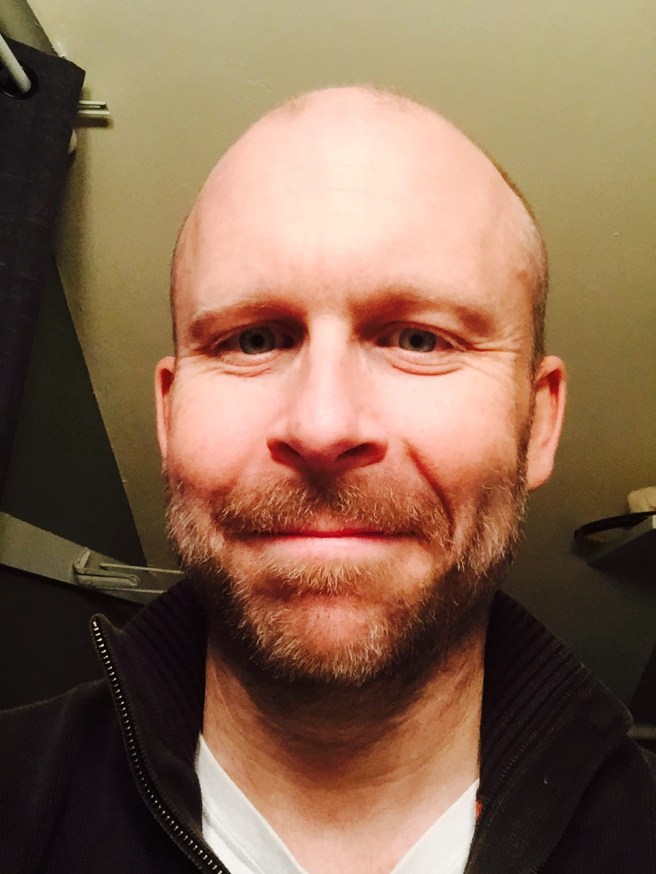
Now that this blog is up and running I find myself wanting to justify it with an update, even though I’m still a month away from the stem cell transplant that is going to decide the length of the rest of my life, and what kind of life it will be. So here is some news: my hair is growing back. I discovered just how quickly during my recent stay in the hospital when I found myself without the handy electric shaver I’d been using over the past few months to keep my previously patchy, slow-growing stubble from getting too raspy. Since the stakes of my personal appearance were more than usually low, I decided to let my hair grow, and after a few days (during which the consensus was that I looked like a convict) it has come back pretty much in the same patterns as before chemo, though maybe a touch darker. I must admit it’s nice to have the beard back; I have found that without it, people often don’t recognize me at all. 
FullSizeRender-5
Anyway, in honour of many a hockey player before me, I’m calling this iteration of facial hair my playoff beard. You know, the kind of facial hair NHL players start growing when their team enters the postseason, and which they pledge not to shave off until they have either been eliminated from contention or achieved their ultimate objective. So this beard is going to be with me until the cytoxan from the preparatory chemo regimen wipes it out, by which time I hope my new immune system will be working on keeping me cancer-free for good (my version of winning the Stanley Cup). 
 
No, sports metaphors don’t seem out of place where the struggle with cancer is concerned, at least not for me. I don’t imagine anyone can ever “beat” cancer in the sense of defeating it as a disease in the world, but I do think that it helps to picture this health crisis as a strange kind of athletic contest between my team (family, friends, doctors, nurses, my fellow cancer patients) and the mindless, perverse cells in my body that want to destroy the rest of me. It is a deadly serious game, but it has certain physical parameters, very strict rules and a final goal, however distant it may seem. There is also a sense in which I gain positive energy from thinking of my private struggle with cancer as a collective effort, just like playing on a soccer or hockey team. In fact, there’s a way in which cancer has made me aware of just how astonishing and moving the collective efforts of humans really are: the struggle to defeat an opponent we know we can’t possibly destroy for good, only keep at bay in particular cases, is an incredible testament to our resourcefulness and, more importantly, to our (often all too hard to discern) solidarity as a species. The time, energy, money, and other resources it takes for me to get just one successful chemo treatment is staggering, but we humans have somehow agreed that, where possible, it’s worth trying to save an individual life, even at great expense and against terrible odds (and my odds aren’t bad at all, though with a cancer as rare as mine there are few guarantees or even dependable statistics). We spend a lot of energy killing and hating each other, it is true, but I can’t help believing that these negative energies are dwarfed by the positive ones. 
 
Of course, I’m very lucky to be getting good care from a fantastic cancer center, of course, and to have a good job that will make as many allowances for me as I need. But the fundamental reality is that, all things being equal, people do tend to rally around our weakest, most vulnerable team members and work to get them through their problems. In any event, there is no way I could deal with this disease alone, and I’m grateful for everyone’s efforts and good wishes on my behalf. Oddly enough, sometimes I feel this most keenly when I’m by myself in an isolation room at the hospital; even when I am alone I still feel connected to, and dependent on, so many others. As my daughters’ soccer coaches remind their players, when we are at our best, we win as a team and lose as a team.
 
So right now this beard is a token of my commitment to seeing this terrible cancer business through to the end as best I can, and to my necessary single-mindedness in that purpose. I still have what feels like a long way to go before I can even turn my body and destiny over to the UC Davis doctors and nurses on January 3, and I have to do my very best to stay completely healthy in the meantime. Even a slight fever for a cancer patient undergoing chemo means a trip to the ER and time in the hospital, and for me it also means possible delays or compromises with my transplant timetable, which involves many other people and lots of logistics. This complex process includes the sacrifices made by my brother, who will be flying out to Sacramento twice in the next month to get examined, poked, prodded, given injections over a 5-day period to ramp up his stem cell production, and hooked up to a machine that will harvest millions of his stem cells from his blood. 
I still don’t know what caused the infection or virus that produced my fevers before Thanksgiving, but I can’t afford another such episode at this crucial juncture. This means that if there is any doubt at all about my immune system or my overall health in the coming weeks I won’t be seeing friends, answering the door, taking my kids to school, or eating out. I hope everyone will understand that these precautions are necessary, even if only for psychological reasons. Like any cliché-mongering hockey player, I need to feel that I am giving 110% percent, respecting my opponent, taking it one game at a time. You know the usual phrases. They are used because they work, and sometimes they are the only language that does. After all, the regular season is over, and now it’s do or die.